
 Get Demo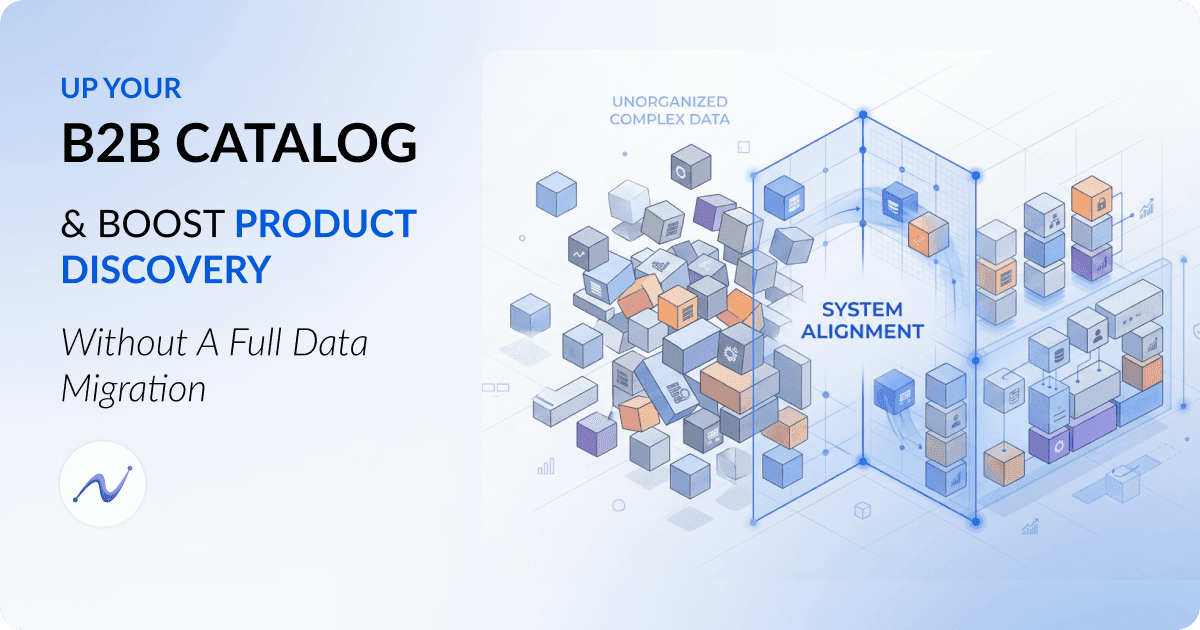

Background
The rapid growth of B2B marketplaces has created enormous opportunities for suppliers and buyers alike. However, the scale of these platforms introduces a significant operational challenge: managing large product catalogs sourced from multiple vendors.
One mid-sized B2B marketplace operating in the industrial supplies sector experienced exactly this challenge. The platform had grown quickly over several years and had onboarded hundreds of suppliers offering thousands of product listings.
By the time the organization began evaluating catalog intelligence solutions, the platform had accumulated:
- Over 120,000 active product listings
- More than 200 suppliers
- Thousands of catalog updates every week
While the marketplace had successfully scaled its supplier ecosystem, the underlying catalog infrastructure had not evolved at the same pace.
As a result, the product catalog had become increasingly fragmented.
The Problem
The marketplace faced three major catalog-related issues.
1. Duplicate Product Listings
Many suppliers sold identical products but submitted product data in slightly different formats.
Examples included:
- Different product titles for the same SKU
- Inconsistent brand names
- Varying product descriptions
- Missing identifiers such as GTIN codes
Because the marketplace lacked automated duplicate detection, the same product often appeared multiple times in search results.
This created confusion for buyers.
2. Inconsistent Product Attributes
Product attributes such as dimensions, weight, and material specifications were often missing or inconsistent across supplier feeds.
This made it difficult for buyers to compare products effectively.
Search filters also became unreliable due to inconsistent attribute data.
3. Increasing Operational Workload
The catalog operations team attempted to manually clean the catalog.
However, the scale of the catalog made manual cleanup impractical.
Catalog managers spent a large portion of their time:
- Reviewing supplier product feeds
- Merging duplicate listings
- Correcting attribute inconsistencies
Despite these efforts, the catalog continued to deteriorate as new supplier feeds were added.
Investigation
The organization conducted an internal audit to understand the scale of the catalog problem.
The audit revealed several key insights.
- Approximately 38% of the catalog contained duplicate or near-duplicate listings.
- More than 40% of products had incomplete attribute data.
- Catalog operations teams spent over 30 hours per week manually reviewing product listings.
It became clear that manual catalog management could not keep up with the platform's growth.
The organization needed an automated approach to product data governance.
The Solution
The marketplace deployed CatalogingPro, the catalog intelligence agent within the NeuroRetail platform.
CatalogingPro was integrated with the marketplace's supplier feed infrastructure.
The platform began analysing product data using multiple signals, including:
- Product titles
- Attribute similarity
- Manufacturer identifiers
- GTIN and UPC codes
- Product images
- Category mappings
Using machine learning models, CatalogingPro identified clusters of products likely representing the same SKU.
For high-confidence matches, the system automatically merged duplicate listings.
For borderline cases, catalog managers reviewed the recommendations through a human-in-the-loop interface.
Implementation
The deployment occurred in three phases.
Phase 1: Data Normalization
The system normalized product attributes across supplier feeds.
This included:
- Standardizing units of measurement
- Normalizing brand names
- Cleaning product titles
This step ensured that duplicate detection models could accurately compare product listings.
Phase 2: Duplicate Detection
CatalogingPro analysed product listings to identify duplicate SKUs.
Duplicate clusters were created and prioritised based on confidence scores.
Phase 3: Catalog Consolidation
Duplicate products were merged into unified product records.
The system preserved supplier-specific information while maintaining a single canonical product listing.
Results
Within the first three months of deployment, the marketplace experienced measurable improvements.
Key results included:
45% Reduction in Duplicate Product Listings
Catalog duplication dropped significantly as automated detection and consolidation improved product data quality.
60% Improvement in Attribute Completeness
AI-powered attribute extraction filled missing product specifications across the catalog.
Improved Search Relevance
Search results became more accurate because duplicate listings were removed and attributes were standardized.
Reduced Catalog Operations Workload
Catalog teams spent significantly less time performing manual cleanup tasks.
Business Impact
The improvements in catalog quality had a direct impact on marketplace performance.
Buyers were able to find relevant products faster, improving overall platform usability.
Supplier onboarding also became easier because the platform enforced standardized catalog requirements.
Most importantly, the marketplace gained the ability to scale its supplier ecosystem without sacrificing catalog quality.
Lessons Learned
The organization learned several key lessons during this transformation.
- Catalog quality directly affects buyer experience and platform credibility.
- Manual catalog management cannot scale with modern marketplace growth.
- AI-powered catalog intelligence can transform product data from an operational burden into a strategic advantage.
Conclusion
Product catalogs are the foundation of any commerce platform.
Without structured product data, search, discovery, and procurement workflows break down.
By adopting catalog intelligence automation, the marketplace successfully transformed its catalog infrastructure and positioned itself for future growth.